In a market as competitive as the snack food sector, efficiency and quality are non-negotiable. Manufacturers are constantly on the lookout for ingredients that not only optimise costs but also ensure a perfect sensory experience for the end consumer. Against this backdrop, the physical modification of starches has become an indispensable tool.
In the snack food industry, innovation in ingredients is key to producing high-quality, consistent products that meet consumer demands. Among these ingredients, pregelatinised flours have come to the fore thanks to their technological functionality and versatility across various production processes.
What are pregelatinised flours and how do they work?
To understand their impact, we must first understand their nature. Pre-gelatinised flours are those that have undergone a heat treatment that gelatinizes the starch, enabling them to absorb water and develop viscosity without the need for further cooking.
This means the ingredient is already ‘ready to use’ at room temperature, which is a real game-changer on the production line.
This feature offers numerous benefits in the production of directly expanded, indirectly expanded and stackable snacks. Below, we examine how it works in each of these applications:
1. Directly expanded snacks (direct extrusion)
In directly expanded snacks, such as those produced by extrusion, pregelatinised flours facilitate more uniform and controlled expansion. This results in a better texture, increased crispness and reduced variability in the final product. Furthermore, they enable process conditions to be optimised, thereby reducing energy consumption.
2. Indirectly expanded snacks (pellets)
In the case of indirectly expanded snacks, where pellets are first formed and then expanded, pregelatinised flours help to improve the structural stability of the pellets. This allows for more precise control during the secondary expansion phase, resulting in a more uniform shape and texture.
3. Stackable products (tinned crisps and shaped crisps)
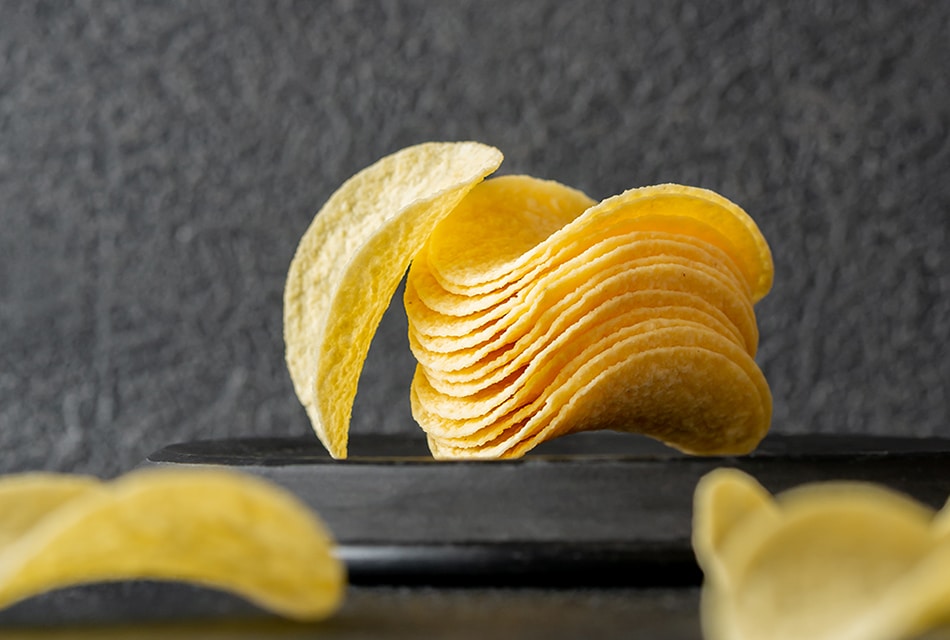
For stackable products, such as moulded crisps, these flours offer excellent dough-forming properties. They facilitate rolling and moulding, improving dough cohesion and reducing defects such as breakage or uneven edges. The result is a final product with improved appearance and consistency.
On high-speed production lines, a brittle dough leads to machine downtime and financial losses. By providing immediate elasticity and viscosity at cold temperatures, the dough flows smoothly through the rolling pins, ensuring that each wafer fits perfectly into the packaging.
The strategic partner for the future of the sector
In short, the use of pregelatinised flours enables snack manufacturers to improve process efficiency, optimise product texture and quality, and offer innovative solutions tailored to market trends.
At Molendum Ingredients, we are committed to ingredients that boost industrial performance and the quality of the final product. We are dedicated to working alongside the industry to co-design bespoke solutions that turn production challenges into competitive commercial advantages.