As we have seen in previous articles, the versatility offered by extrusion in the food industry is a major advantage over traditional methods of processing cereals and legumes. However, it is also important to understand that this process is not limited to a single machine, the extruder, but rather comprises a series of equipment, each designed for a specific function and whose use will inevitably determine the final result.
The pillar of stability: precise dosing
In summary, the extrusion process used for flour treatment consists of two stages: heat treatment (or conditioning) and mechanical treatment (extrusion phase). However, prior to these two phases, an essential step in this process is often overlooked: the dosing of the raw material itself. It should be noted that all the parameters of the extrusion process are determined by the capacity of the machine, so it is necessary to install a gravimetric dosing device or a very precise flow controller to ensure a constant feed.
An error in dosing, even of a small percentage, alters the residence time of the product inside the extruder. This modifies the specific mechanical energy (SME) transferred to the mass, which can cause the product to come out raw or, conversely, excessively burnt.
Pre-cooking: conditioning and gelatinisation
Once the dosage has been ensured, you can move on to the first step of the cooking process: conditioning the raw material. Conditioning refers to the process by which dry flour is moistened while increasing the temperature. Thus, by applying thermal energy, the starches begin to gelatinise. At this stage, it is essential to obtain a completely homogeneous dough that allows us to work steadily in the next machine. On the other hand, the particle size or granulometry of the flour we are using as raw material is also decisive here: the degree of cooking will depend on how easy it is to introduce thermal energy into the particle to be treated.
The gelatinisation process that begins here is an irreversible change in which the starch granules absorb water and lose their crystalline structure. If the particle size is not uniform, the large particles will remain with a dry core (‘fish eye’), affecting the sensory quality of the final product.
Mechanical transformation: shearing and dextrinisation
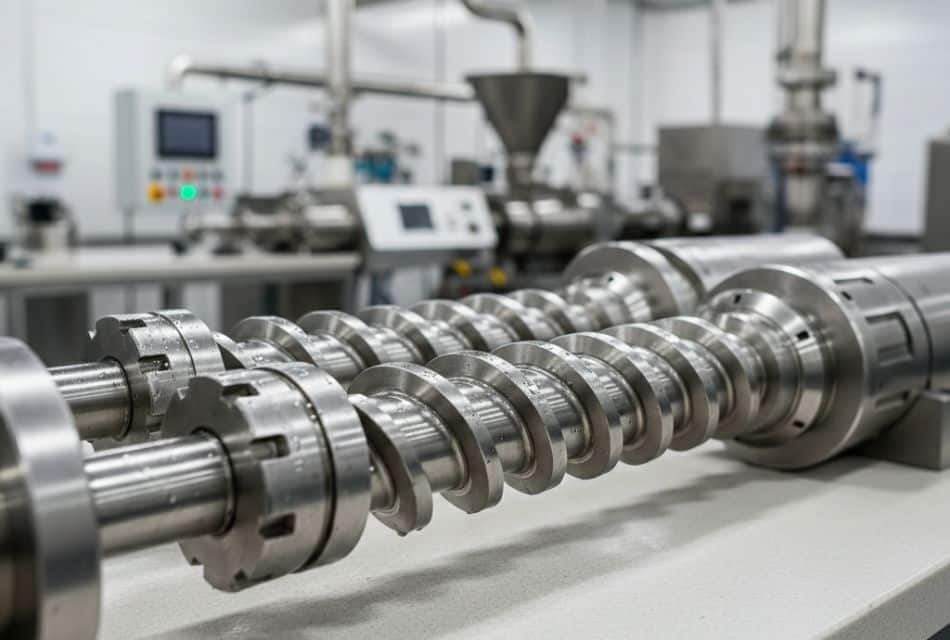
Now that the product has been cooked, it is time to carry out the mechanical treatment. This is done in an extruder that can have one or two shafts. Although the machine may seem simple, it is essential to be aware that several processes are taking place at the same time. On the one hand, the starches continue to gelatinise due to the presence of water in the process. On the other hand, the rotation of the motor, the configuration of the shafts and the friction exerted on the raw material cause another chemical change in the starches called dextrinisation.
While gelatinisation requires water, dextrinisation is the result of the mechanical breakdown of starch chains. In twin-screw extruders, control of this phase is superior, allowing ingredients with high fibre or protein content to be handled that would be difficult to process in single-screw machines.
The critical point: pellet expansion and formation
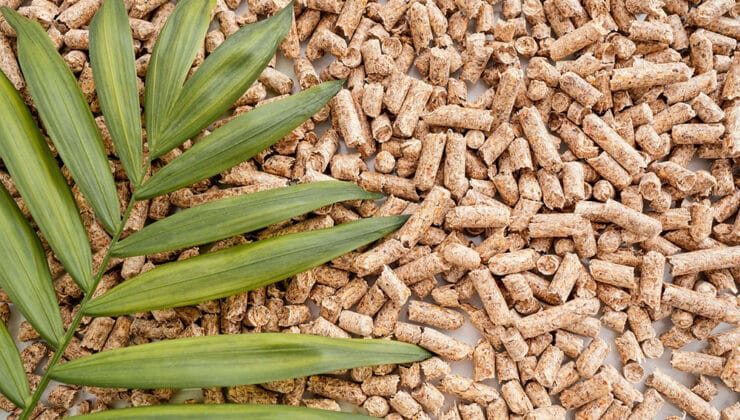
The extrusion process culminates in the expansion phase. It should be noted that temperatures inside the machine can exceed 160 °C and pressures can reach several dozen bars, so when the cooked mass is released at ambient temperature and pressure, the water will instantly turn into steam. A rotating cutter located at the end of the extruder cuts the product into pellets, which facilitates transport to the next stage of the process.
This phenomenon is known as flash-off. The sudden drop in pressure causes the structure of the mass to ‘inflate’, creating a porous network. The speed of the blades in the cutter will determine not only the size, but also the aerodynamic shape of the pellet, which is crucial for subsequent uniform drying.
Stabilisation and finishing: drying and final grinding
Finally, the pellets into which the flour has been transformed are dried. This is usually done using large industrial dryers that reduce the moisture content to the optimum level for the last step in the process: grinding. Whether for the production of pregelatinised flours or breadcrumbs, the pellets must be ground to the particle size desired by the customer.
Drying is vital for food safety (water activity) and for grinding. A pellet with residual elastic moisture does not break down properly in the mill, which would result in a final product that does not meet technical specifications.
In conclusion, what appears to be a simple machine is actually a very complex process involving a multitude of parameters and physical and chemical changes. Extensive theoretical knowledge and practical experience are required to obtain the correct end product and to achieve new developments.