Making good bread is an art. Although its recipe may seem simple, its preparation requires technique, experience and control to achieve a quality product.
Key ingredients in baking
Flour: the basis of everything
Flour is the main ingredient in bread formulation, it has a number of intrinsic characteristics (e.g. gluten percentage and quality) or extrinsic characteristics (e.g. moisture), which affect its behaviour in the baking process. Its quality (especially in terms of gluten) directly influences water absorption and the formation of an elastic network that retains the gas generated during fermentation, resulting in more manageable doughs. This results in breads with better volume and a more uniform honeycombing.
And the salt? Beyond flavour
In addition to enhancing flavour, salt during the kneading process reinforces the gluten network that is formed, improves water absorption by improving the rheological characteristics of the dough and slows down the fermentation capacity, helping to control the process.
Dough hydration: essential balance
The percentage of water influences the viscosity and workability of the dough. As flour can vary due to factors such as harvesting or storage, it is important to adjust the hydration to obtain the ideal texture for each dough.
Kneading: developing the gluten network
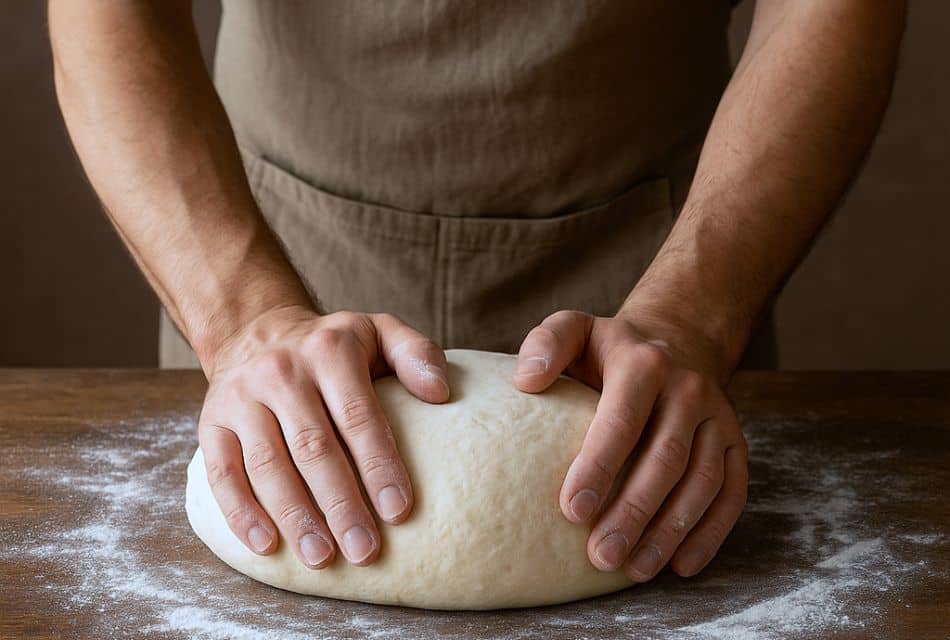
Kneading activates the gluten and defines the structure of the bread. Higher protein flours require higher intensity to develop the gluten network properly, as their greater strength will put up more ‘resistance’. In addition, it is crucial to control the final temperature of the dough (ideally 25 °C), as it influences its extensibility and tenacity. This temperature depends on several factors such as flour temperature, baker’s temperature and water temperature, but the latter is the only adjustable parameter.
Fermentation and baking: where the magic happens
During fermentation, yeast transforms sugars into gas, and a well-developed gluten network is key to retaining it, resulting in a loaf with greater volume and homogeneous honeycombing.
In the oven the increase in temperature causes a migration of moisture from the centre of the dough outwards, causing the moisture to evaporate and the crust to form. Applying steam at the beginning allows the crust to form later, giving the bread time to expand, before the crust forms. At surface temperatures of 130 °C, Maillard and caramelisation reactions provide colour and aroma.
Pregelatinised flours: innovation in dough
Pregelatinised flours, such as those developed by Molendum Ingredients, offer significant advantages:
- Greater water absorption, without altering the texture of the dough.
- Better workability, especially in sticky doughs.
- Faster fermentations, thanks to a higher content of available sugars.
- More homogeneous honeycombing and reduced moisture loss, even during storage.
- Increased shelf life, due to longer shelf life.
- More intense colour, due to accelerated Maillard reactions and rind formation.
In short
Incorporating pre-gelatinised flours into your baking process not only improves efficiency, but also the quality of the end product. From a more manageable dough to a more voluminous, tender and tasty bread, this is an innovative solution with added value for bakery professionals and enthusiasts.